
(Micky Crocker’s mother, based on interviews by Westford Academy students Angela Antos and Kerry Wilson)
Sally McKniff (Sarah Lavelle) was born on September 9, 1898, in Keighley, Yorkshire, England. She began working in a textile mill at age 12 and became an experienced mill worker.
In 1923, at age 25, Sally moved to the United States after her sister Mary Ellen Lavelle, who lived in Forge Village in Westford, sent for her. She went to work at the Abbot Worsted Mill. Three years later, in 1926, she married Thomas John McKniff, also from Keighley, Yorkshire, England. In 1928, their only child, Helena Anne McKniff (Micky Crocker), was born in Forge Village.
At the mill, Sally worked in twisting and spooling, which were near the end of the production process. The steps she described were: twisting the yarn, then winding, spooling, warping, and finally weaving, which was done at another location.
Mill workers had long hours—10 hours a day, five and a half days a week, totaling 56 hours. Sally earned $4.20 per week.
Work at the mill was not always steady. During the Great Depression, Sally’s husband, a wool sorter, was out of work for nine months. There was no unemployment support, so the family relied on their savings and food from their Victory Garden.
The mill owner, Mr. Abbot, owned all the houses in Forge Village and Nabnasset (then called Brookside). Rent was taken directly from workers’ pay. When workers had no income, rent payments were delayed and later deducted once they returned to work. At times, Sally’s husband brought home as little as $7 a week, or even less after rent was deducted. Nearly everyone in Forge Village worked at the mill.
Mill workers came from many countries, including Poland, Russia, France, and England.
When Sally first arrived, she lived at 12 Central Street (later renamed Prescott Street) in Forge Village. After getting married, she moved to 12 Palermo Street, where she lived for 50 years.
At that time, there were no cars in town. People relied on public transportation, including four trains a day and a bus that came every 20 minutes. The bus traveled to Ayer and Lowell, with a transfer in North Chelmsford. As cars became more common, bus service was eventually discontinued.
Medical care was limited. Doctors in Westford and Graniteville worked out of local stores. Sally once had a tooth pulled in the back of a store using only pliers and was told to “go out the back and spit.”
For recreation, Sally joined the Abbot Worsted Club Bowling League, which met at what is now the Elks Club. The league had five teams. She also enjoyed dancing at the Commodore in Lowell and going to the movies at the Westford Hall, where tickets cost 25 cents.
Mr. Jack Abbot also supported a local soccer team. The team and its fans, including Sally, traveled by private train to games in places like Rhode Island, Fall River, and Methuen.
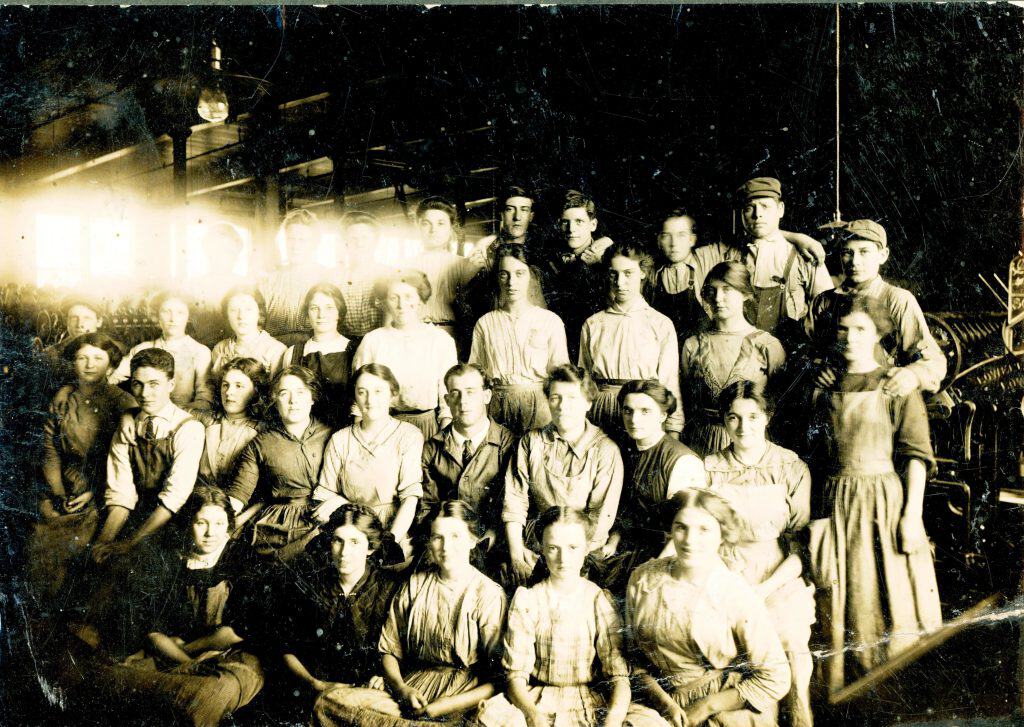
Abbot Worsted Yarn Mill Workers
Doffers, Spinners & Twisters
2nd Row: Mary Mulligan, Jim Mulligan, Mary Kelly Lord,
SALLY LAVELLE MCKNIFF, Mary Merrick, Francis Drolet,
Gert Baker, ? , Nellie Merrick Brown
From the Helena Crocker Collection
Please note that the only names listed on the back of the picture are in the 2nd row. If you can identify anyone else in the picture, please let us know at: director@museum.westford.org